
Kristin Lobron
May 12, 2026
Job numbers. GDP. Number of workers trained. Housing price index. These are all interesting numbers but they fail to explain what one of my mentors used to call 'prosperity' and I'll call good, livable communities. You can create thousands of jobs, but if they are minimum wage, it will not make people move to your community to obtain the job. Those jobs do not provide extra funds for investing in your home, your community, or your child's education. This is not 'prosperity'. There is a need to move to new metrics. Here, I argue, especially for investments in the creative economy. The "creative economy" is a term encompassing overlapping mechanisms:
· Creative industries. Graphic design, marketing, food, music, architecture, human-centered design, art, event planning, creators, film, and more.
· Public art and design. From murals to transportation design, creatives, designers, and cultural practitioners have roles in developing the communities we live in.
· Crafting and DIY. Etsy, crafts, DIY house projects, gardening, and the everyday creative practice that runs alongside formal industries.
· Education. Formal and informal classes available to the public, higher education programs, and the incorporation of arts in primary and secondary schools.
· Cross-sectoral impacts. Sustainable reuse of materials, designing better water systems, designing better health care systems and buildings, and the design work embedded across every other industry. (See the UN's orange economy report for one good framing.)
Without a clear definition, impacting the creative economy — and the impact of the creative economy — can be elusive, and the attribution gets seconded to other mechanisms. The result is a consistent underinvestment in creatives, designers, and social changemakers. I'll argue that investments in creatives and designers build assets and provide diverse impacts in ways other investments cannot, even if the definition is fuzzy.
Most of the case for creative-economy investment gets made in economic terms — jobs, GDP, audience spending, tax revenue. Those numbers matter, and I'll cite some of them below. But economic returns are only one of the categories of value creative work produces, and treating them as the whole story is part of why creatives and designers stay chronically underinvested: returns that compound across multiple categories get credited to one category at a time, and look smaller than they are.
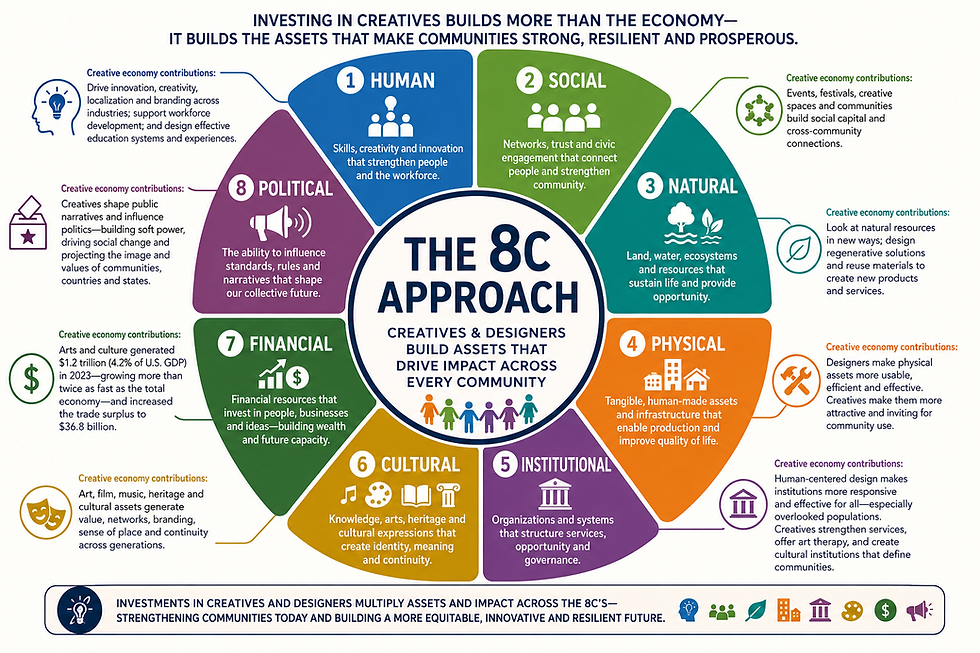
A more honest accounting takes a multi-capital view. The SAS Foundation for Community Assets Development in Sudan describes eight assets — or capitals — that every community has. Below, I walk through each and the lasting impact creatives and designers have on it.
Human. Human capital is the economic value of a worker's experience and skills. Investments in creatives drive innovation, creativity, localization, and branding across industries; creativity can support workforce development; and design is a pinnacle for developing workforce systems. Bowen and Kisida's 2019 randomized controlled trial of 10,548 students across 42 Houston schools found that students randomly assigned to receive arts educational experiences showed a 13 percent of a standard deviation improvement in standardized writing scores, a 3.6 percentage point reduction in disciplinary infractions, and an 8 percent of a standard deviation increase in compassion for others — with elementary students additionally showing increased school engagement and college aspirations.
Social. Social capital is the value of social networks, which leads to trust, higher civic engagement, more involvement in community, and more connections across differences. Creative economy contributions — events, festivals, creative communities, shared cultural participation — all build social capital and community networks. NEA research consistently finds that adults who engage with the arts are significantly more likely to vote, volunteer, and engage civically than those who don't.
Natural. Natural capital includes land, forests, water, and similar resources, along with the ecosystem services that support them. Creatives and designers help us look at natural resources in new ways: as inputs to new products and services, as the basis for regenerative design, and as materials to reuse rather than discard. Designers also shape the built and material environment through which most people encounter the natural world at all, which makes them more central to ecological stewardship than the conventional framing acknowledges.
Physical. Physical capital is the tangible, human-made goods that aid in creating a product or service — properties, equipment, and inventory. Designers make physical assets more usable, efficient, and effective, whether the asset is a piece of machinery or a piece of real estate. Creatives make these physical assets more attractive for community use. Knight Foundation's three-year Soul of the Community study of 26 U.S. cities found that aesthetics, social offerings, and openness — all products of creative work — correlate with local economic growth more strongly than perceptions of the economy itself.
Institutional. Institutions are organizations that may or may not have physical structures: government agencies, universities, hospitals, nonprofits, school districts, art institutions, theaters, and the like. Human-centered designers make these institutions more responsive and effective to those they serve, including often-overlooked populations like the elderly, the disabled, and the homebound. Creatives can increase the effectiveness of services — offering art therapy, for example — or are the institution themselves, as with museums. Art and cultural institutions, and the ecosystems contributing to those institutions, often distinguish communities and attract both residents and tourists.
Cultural. Cultural capital encompasses the cultural resources a person possesses, including their knowledge, skills, education, taste, and cultural networks. Art, film, music, and historical artifact collectors and connoisseurs, among others, understand the financial value of cultural products. Motown, jazz, the Bolshoi ballet, and countless other examples are cultural assets that produce power, networks, branding, sense of place, continuity across generations, and other intangible value that helps knit us together as humans. Cultural assets are both historical and present, and they're dynamic in how they influence and react with communities — building tangible and intangible assets from creativity and design.
Financial. Financial capital is the resource pool available to invest in community capacity building, underwrite business development, support civic and social entrepreneurship, and accumulate wealth for future community development. The arts and cultural sector grew at more than twice the rate of the total economy between 2022 and 2023, according to new data from the Arts and Cultural Production Satellite Account (ACPSA), a product of the National Endowment for the Arts and the Bureau of Economic Analysis. In 2023, the most recent year for which data are available, arts and culture again surpassed its annual value added to the U.S. economy at $1.2 trillion, representing 4.2 percent of the nation's GDP. The trade surplus rose from $21.5 billion to $36.8 billion between 2022 and 2023, surpassing 2019 levels.
Political. Political capital is the ability to influence standards, rules, regulations, and their enforcement. Creatives influence politics every day, sometimes in powerful ways. The singing revolution in Estonia and the creative humor and music of the Otpor movement in Serbia both contributed to the downfall of dictators. Graphic designers, filmmakers, photographers, and other creatives shape the way we see the political world around us, including how we see candidates. Investing in creatives builds soft power and projects an image of community, country, or state. Romans, Greeks, Mayans, Nubians, Songhai, Zhou, and many other civilizations invested in creatives to build and wield their political power.
Why this matters, and what comes next.
Read any one of these in isolation and the case for creative-economy investment sounds like an advocacy argument. Read them together and something different appears: creative investment is one of the only categories that produces measurable returns across every one of these eight capitals simultaneously. Housing investment moves physical and financial capital. Workforce development moves human and financial. Infrastructure spending moves physical and natural. Creative investment moves all eight — which is precisely why its returns get systematically under-counted by accounting frameworks built around single-sector evaluation.
I'm working on a framework I'm calling the Eight-Capital Creative Economy Impact Framework (8C) — a way for creative, design, and cultural organizations to measure and articulate the returns on creative investment across all of these asset categories, not just the economic one. More on that soon. For now, the point is the simpler one: if you only measure what economists measure, you'll only fund what economists fund. And that's been the problem all along.